.jpg?width=1000)
What is Sangam Literature?
Tamil Sangam literature is one of the oldest surviving secular literary traditions in the world. Written roughly between 300 BCE and 300 CE by hundreds of poets, it comprises thousands of poems about love, war, nature, ethics, and the cosmos. The word Sangam (சங்கம்) refers to an ancient academy of Tamil scholars who gathered, debated, and preserved this poetry.
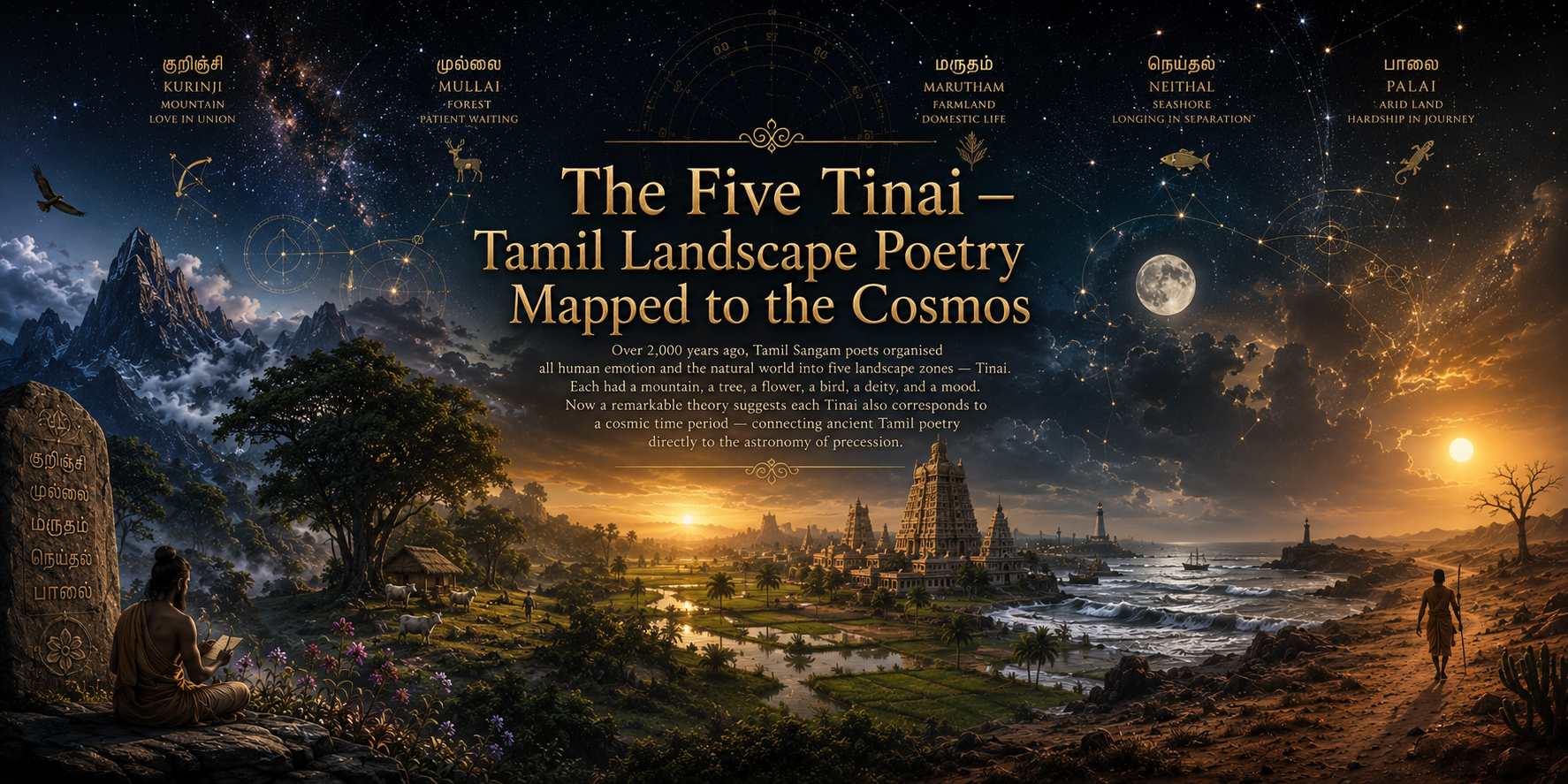
The Sangam poems are remarkable for their precision. They do not simply describe emotion — they map every human feeling to a specific natural setting, time of day, season, plant, bird, and deity. This mapping system is called the Tinai (திணை) framework — one of the most sophisticated literary classifications ever devised.
The Five Tinai — Landscapes of Human Experience
Classical Tamil Sangam poetry divides the natural world — and by extension, all human emotional experience — into five landscape zones:
| Tinai | Tamil | Landscape | Deity | Mood / Emotion | Time of Day | Season |
|---|---|---|---|---|---|---|
| Kurinji | குறிஞ்சி | Mountain & Forest | Murugan | Union / Love's first meeting | Night | Cold season |
| Mullai | முல்லை | Forest & Pasture | Thirumal (Vishnu) | Waiting / Patient longing | Evening | Rainy season |
| Marutham | மருதம் | Agricultural Fields | Indra | Infidelity / Lovers' quarrel | Dawn | All seasons |
| Neythal | நெய்தல் | Seashore & Coast | Varunan | Longing / Separation near the sea | Afternoon | All seasons |
| Paalai | பாலை | Desert / Wasteland | Krishnan (Kotravai) | Separation / Difficult parting | Noon | Harsh summer |
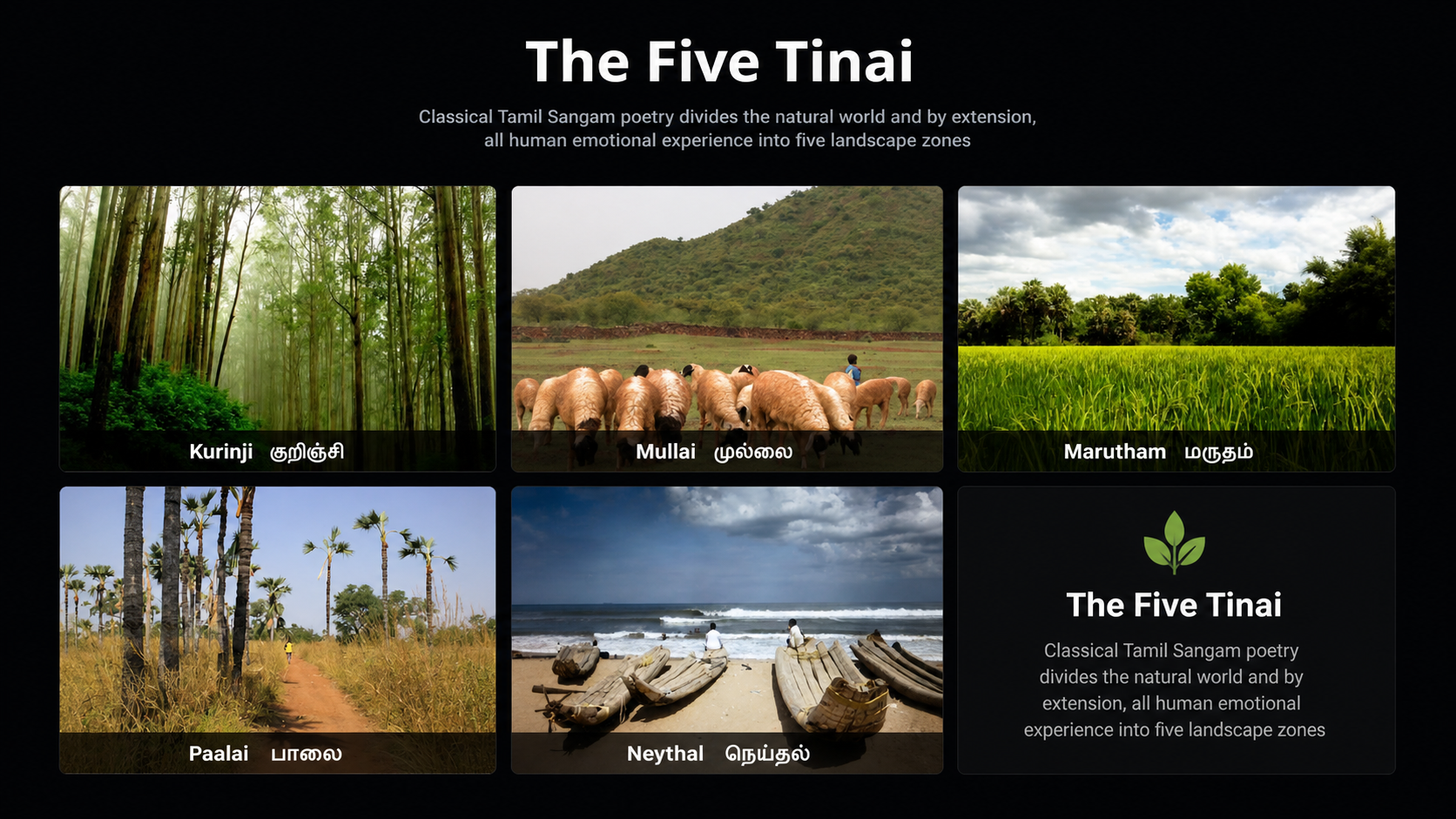
Every Sangam love poem is set within one of these five landscapes, and a Tamil reader immediately knew the emotional register of the poem from its setting alone — as precisely as a musician knows a melody's mood from its key. A poem about mountains meant union; a poem about the seashore meant longing.
Each Tinai's Natural Emblems
The Tinai system extends beyond landscape to a complete ecological signature — each Tinai has its own specific:
| Tinai | Hill / Landmark | Tree / Plant | Flower | Bird | Drum |
|---|---|---|---|---|---|
| Kurinji | Mountains | Kurinji shrub | Kurinji flower (blooms every 12 years!) | Parrot | Kinar |
| Mullai | Forest hills | Mullai creeper (jasmine) | Mullai flower | Kokku (peacock) | Muzhavu |
| Marutham | River delta / fields | Maruthu tree | White water lily | Heron | Maddalam |
| Neythal | Seashore | Punnai tree | Blue water lily | Seagull | Meermin |
| Paalai | Desert | Palai tree | Palai flower | Crow | Tudumbu |
Note the remarkable detail: the Kurinji flower (Strobilanthes kunthiana) blooms only once every 12 years — precisely the same period as Jupiter's zodiacal cycle. Was this a coincidence the ancient Tamil poets noticed?
The Cosmic Time Theory — Tinai and Precession
The theory explored in our companion article on Thirukkural proposes that the five Tinai may also encode cosmic time periods — portions of Earth's 26,000-year precessional cycle. The mapping, according to this theory, is:
| Tinai | Deity | Emotional Theme | Proposed Cosmic Period |
|---|---|---|---|
| Kurinji (Hills) | Murugan | Union / New beginning | ~1,200 years |
| Mullai (Forest) | Thirumal | Patience / Nurturing | ~5,000 years |
| Marutham (Fields) | Indra | Activity / Disruption | Transitional |
| Neythal (Sea) | Varunan | Longing / Flux | Transitional |
| Paalai (Desert) | Krishnan | Separation / Ending | ~5,400 years |
Important note: The Tinai-cosmic time mapping is a modern interpretive theory, not established in classical Sangam scholarship. It is presented as a thought-provoking connection between Tamil literary and astronomical traditions, inviting further scholarly exploration.
Why This Connection is Fascinating
Whether or not the cosmic time mapping is intentional, the Tinai system reveals something profound: ancient Tamil thinkers did not separate poetry from science, emotion from nature, or the human world from the cosmos. The sky and the landscape, the star and the flower, the deity and the season — all were part of one interconnected system.
When a Sangam poet wrote about union in the mountain landscape, they were simultaneously invoking Murugan (the sky deity), the Pleiades (Karthigai — his Nakshatra), the cold mountain night, the Kurinji flower — and perhaps, in the deepest layer of their tradition, a cosmic age of beginning and union. Everything was connected.
This holistic world-view — where poetry, astronomy, ecology, and theology are facets of one unified understanding — is one of the most distinctive and beautiful features of ancient Tamil civilisation.
The Kurinji Flower and the 12-Year Cycle
The Kurinji flower deserves special mention. Strobilanthes kunthiana is a shrub found in the Nilgiri Hills of Tamil Nadu (its name literally means "blue mountain hills" in Tamil — Nilgiris). It blooms in a spectacular mass flowering event once every 12 years, turning entire hillsides blue-purple.
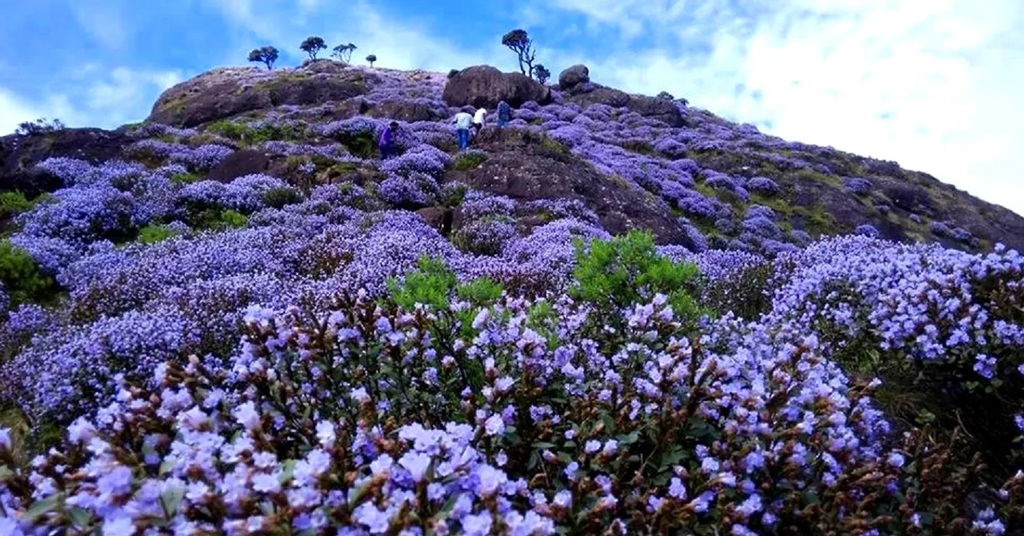
The most recent mass flowering was in 2018. The next will be in 2030. Ancient Tamil people who lived in and around the Nilgiris would have used this rare flowering as a calendar marker — a living astronomical clock set by nature itself to the same 12-year cycle as Jupiter's journey through the zodiac.