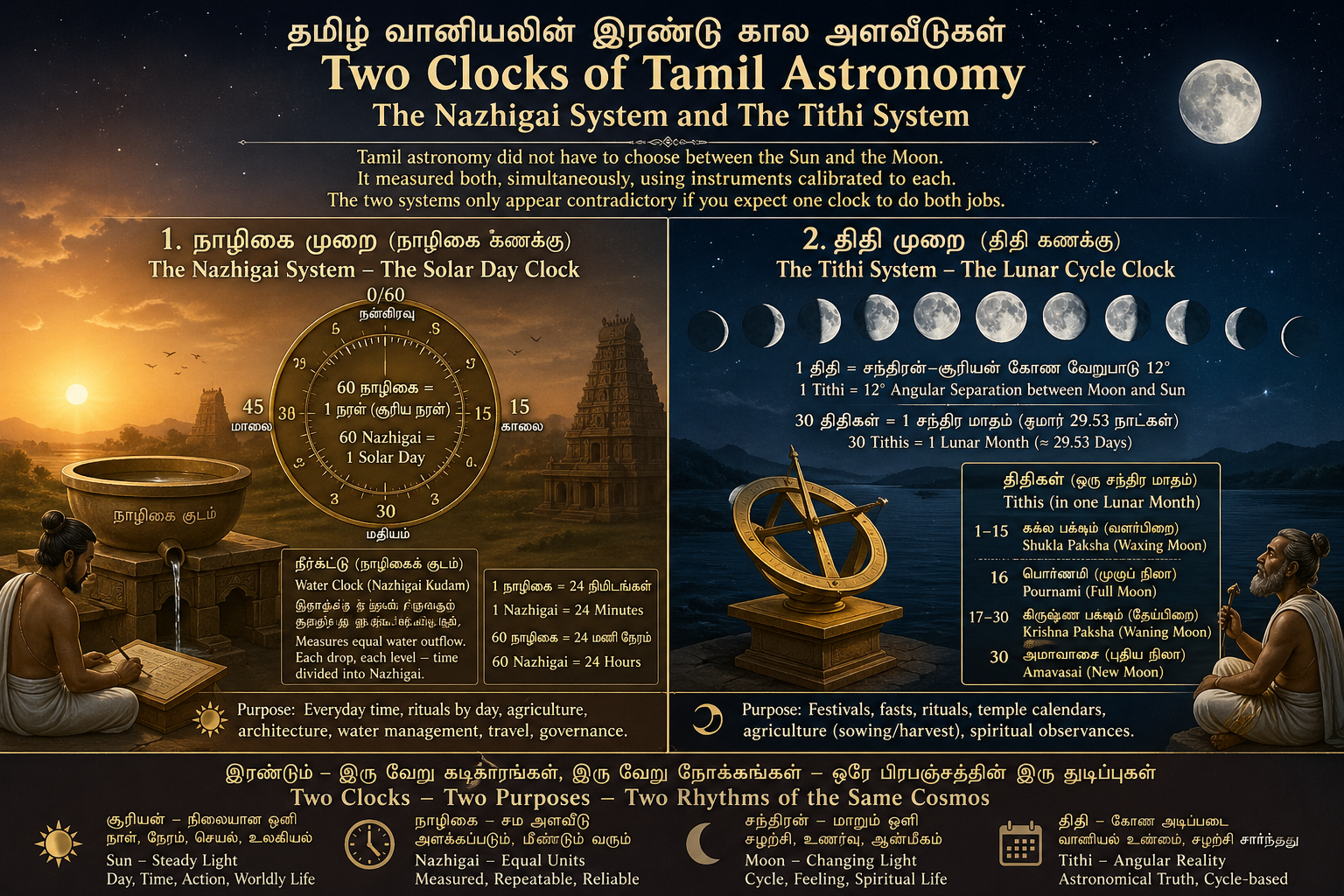
The Tamil tradition maintained two entirely separate timekeeping systems — one for the solar day, one for the lunar cycle — each precise, each purposeful, each encoding a different layer of cosmic reality.
The Nazhigai(நாழிகை) is Tamil astronomy's answer to the question: what time of day is it? It divides the solar day into 60 equal units, each lasting exactly 24 minutes of modern time. The system is purely solar — anchored to sunrise and sunset, governed by the Sun's actual motion, ticking at the same pace every single day regardless of the Moon.
One solar day = 60 nazhigai. One nazhigai = 24 minutes. This is not a coincidence — 60 × 24 = 1440 minutes = exactly one day. The Tamil system and the modern system agree perfectly; they just divide the day differently.
ஒரு நாள் = 60 நாழிகை. ஒரு நாழிகை = 24 நிமிடங்கள். இது சுத்தமான சூரிய நாள் கணக்கு.
The Structure of 60
Why 60? The number 60 divides cleanly into 1, 2, 3, 4, 5, 6, 10, 12, 15, 20, and 30 — more divisors than any other number of similar size. This makes scheduling and calculation frictionless. The day divides into four watches of 15 nazhigai each, eight sessions of 7.5, or twelve intervals of 5 — always whole numbers.
60
Nazhigai per day · நாழிகை/நாள்
Total units in one solar day
ஒரு நாளில் மொத்த நாழிகை
24m
Per nazhigai · ஒரு நாழிகை
Each nazhigai = 24 solar minutes exactly
24 நிமிடம் = 1440 விநாடி
6
Nazhigai per modern hour
60 minutes ÷ 24 min = 2.5, so 6 per hour
1 மணி நேரம் = 2.5 நாழிகை
2.5
Nazhigai per hour
Precise conversion factor
மாற்று விகிதம்
Sub-divisions: Vinazhigai and Mattirai
The nazhigai itself is subdivided for finer precision. One nazhigai contains 60 vinazhigai(விநாழிகை), and each vinazhigai contains 60 mattirai(மாத்திரை) — giving a three-tier sexagesimal (base-60) system remarkably similar to modern hours, minutes, and seconds.
1 mattirai = 24 sec ÷ 60 = 0.4 seconds1 மாத்திரை = 0.4 விநாடி (ஒரு கண் இமைக்கும் நேரம்)
→
Total resolution: 60 × 60 × 60 = 216,000 mattirai per dayA day divided to within 0.4 seconds — finer than most ancient systems
The Eight Traditional Watches — யாமங்கள்
The Tamil day was also divided into eight yaamas(யாமங்கள்) — watches of 7.5 nazhigai (= 3 hours) each. Four for the day, four for the night. Each watch had a name and purpose — prayer, rest, labour, vigil.
INTERACTIVE NAZHIGAI CLOCK · நாழிகை கடிகாரம்Drag the ring to set time
Current Nazhigai
1
06:00 – 06:24
உஷத்காலம் · Pre-dawn
Modern equivalent
24 min = 1 nazhigai
Progress through day
1 / 60
Naz 1Naz 60
Yaama · யாமம்
Nazhigai
Modern Time
Period
Nazhigai vs Modern Hours
The nazhigai is not an approximation of the hour — it is a different choice. Modern time divides the day by 24 then by 60; the nazhigai system divides by 60 then by 60 again. Both reach the same resolution. The difference is philosophical: Tamil time is always expressed as a fraction of the complete day, not an offset from midnight.
Nazhigai
Modern Time (24h)
Period
Tamil Name · தமிழ் பெயர்
· · ✦ · ·
ARTICLE II
The Tithi System திதி — நிலவின் கட்டக் கணக்கு
While the nazhigai tracks the Sun, the Tithi(திதி) tracks the Moon — specifically, the Moon's angular separation from the Sun as it moves through its monthly cycle. One tithi is the time it takes for this separation to increase by exactly 12 degrees. The result is 30 tithis per lunar month, each one a measurable step in the Moon's eternal dance around Earth.
A tithi is not a day. It is a unit of lunar phase progress — a 12° increment of the Moon's position relative to the Sun. It happens to last almost (but not exactly) one solar day.
திதி என்பது நாள் அல்ல. சூரியனிடமிருந்து நிலவின் 12 டிகிரி கோண இடைவெளி நகர்வே ஒரு திதி.
The Geometry of a Tithi
The Moon completes one synodic cycle — new moon back to new moon — in 29.53059 days. During this time it traverses 360° of angular separation from the Sun. Dividing this by 30 gives 12° per tithi. This is why a lunar month always has exactly 30 tithis, regardless of whether the synodic month is 29 or 30 solar days in a given cycle.
①
1 synodic month = 29.53059 solar daysNew moon to new moon — the Moon's actual cycle
②
360° ÷ 30 = 12° per tithiMoon must move 12° away from the Sun for each tithi to complete
③
29.53059 days ÷ 30 = 0.98435 days per tithi= 23 hours 37 minutes 25 seconds — not quite a full solar day
④
1 solar day − 1 tithi = 22 minutes 35 seconds shorterThis gap compounds to the full 5.12-day yearly drift
30
Tithi per month · மாதம்/திதி
Always exactly 30, regardless of solar days
ஒரு மாதம் = 30 திதி
12°
Moon's arc per tithi
Moon's angular separation from Sun advances 12°
சூரியனிடமிருந்து 12 டிகிரி நகர்வு
23h 37m
Duration of one tithi
22 minutes 35 seconds shorter than a solar day
ஒரு திதியின் நேர அளவு
370.37
Tithi per solar year
12.37 synodic months × 30 tithi = 370.37
ஒரு சூரிய ஆண்டில் திதி எண்ணிக்கை
The 30 Tithis: Names and Phases
Each tithi in the 30-day cycle has a name and corresponds to a specific phase of the Moon visible in the sky. The cycle runs from Pratipada (the first day after new moon) through Purnima (full moon on day 15) and back to Amavasya (new moon on day 30).
Click any tithi on the wheel to see its name and phase. Outer ring = Shukla paksha (waxing). Inner ring = Krishna paksha (waning).
Shukla (waxing)Krishna (waning)
Selected Tithi
1
Pratipada
பிரதிபதை
Shukla Paksha · வளர்பிறை
Moon–Sun angle at this tithi
12°
Because a tithi is ~22 minutes shorter than a solar day, any given "tithi time" drifts through the full 24-hour clock every 72 days. Drag the slider to explore.
Day:Day 0
Tithi "6am" now falls at solar…
6:00 am
morning · காலை
Total drift accumulated
0h 00m
Cycle 1 of 3
Over a full year, the difference between 360 tithi-years and 370.37 solar-years becomes the bridge between 72 and 74.074 — the two precession values.
①
74.074 tithi-years × 360 tithi/yr = 26,666 tithi per 1°Convert Tamil precession rate to pure tithi — the common currency
②
26,666 ÷ 370.37 tithi/solar-yr = 72.0 solar years per 1°Re-express in solar years — matches modern science exactly
→
74.074 × 0.9719 = 72.0 ✓Shortcut: multiply Tamil value by the year-type ratio
Why Tithi Has No Fixed Sunrise
Because a tithi is 22 minutes 35 seconds shorter than a solar day, a tithi can begin and end at any solar time. A tithi that starts at sunrise today may start at noon next month, and at midnight the month after that. This is not a flaw — it is the fundamental reason Tamil astronomy kept the two systems entirely separate.
The nazhigai told you when in the solar day you were. The tithi told you where the Moon was in its phase cycle. Asking a tithi "what time is it?" is like asking a calendar "what hour is it?" — they answer different questions.
நாழிகை கேட்கும் கேள்வி: "சூரியன் எங்கே?" திதி கேட்கும் கேள்வி: "நிலா எங்கே?" இரண்டும் வெவ்வேறு கேள்விகளுக்கு விடை சொல்கின்றன.
· · ✦ · ·
THE BRIDGE
Two Systems, One Cosmos இரண்டு முறைகள் — ஒரே பிரபஞ்சம்
Tamil astronomy did not have to choose between the Sun and the Moon. It measured both, simultaneously, using instruments calibrated to each. The two systems only appear contradictory if you expect one clock to do both jobs.
SIDE-BY-SIDE COMPARISON · ஒப்பிட்டு பார்க்கவும்
Nazhigai · நாழிகை
Tithi · திதி
What it tracks
Sun's position · சூரியன்
Moon's phase · நிலவு
Units per cycle
60 per solar day
30 per lunar month
Duration of unit
24 min exactly
23h 37m 25s (varies)
Drift vs solar
None — perfectly fixed
~22m 35s per day
Yearly count
21,900 nazhigai
370.37 tithi
Used for
Prayer, daily schedule, time of day
Ritual, agriculture, astronomy, precession
Tamil units
60 naz → 60 vinaz → 60 mattirai
30 tithi × 12 months = 360/yr
Tells you
What time of day it is
Where the Moon is in its cycle
The 72-Day Connection
The full drift cycle — the number of solar days for a tithi "clock" to complete one full revolution through all solar times — is 72.3 days. This is not unrelated to the 72 years per degree of solar precession: both derive from the same fundamental ratio of tithi-to-solar-year (0.9719). The Tamil number system is self-similar across scales — what holds for a day holds for a century holds for a millennium.
→
24 hours ÷ 22m 35s per day = 72.3 days (one full drift cycle)Daily scale: tithi "6am" returns to solar 6am after 72 days
→
360° ÷ 0.9719 ratio = 72 years per degree of precessionCentennial scale: 1° of solar precession = 72 solar years
→
Both derived from: 360 ÷ 370.37 = 0.9719The same ratio of tithi-year to solar-year operates at every timescale
The Tamil ancestors did not separate nazhigai and tithi because they were confused about timekeeping. They separated them because they understood that the Sun and Moon operate on different geometries, and conflating them loses precision at both scales.
நாழிகையும் திதியும் வெவ்வேறாக இருப்பது குழப்பமல்ல — அது துல்லியம். சூரியனும் நிலவும் வெவ்வேறு வட்டங்களில் இயங்குகின்றன.
· · ✦ · ·
SUMMARY VISUAL
Two Clocks at a Glance ஒரே பார்வையில் இரண்டு காலக் கணக்கு முறைகள்