Tamil Astronomy
& The Wedding
How the Tamil sky — its solar clock, its binary stars, and its fixed pole — became the living witness of every wedding ceremony.
The Sky as Witness வானம் சாட்சி — The cosmos attends every wedding
In Tamil tradition, a wedding is not complete without the sky. Not as backdrop or metaphor — but as a direct astronomical participant. Specific stars must be found and named. The Sun's exact position must be calculated. The sacred fire must face the correct cardinal direction. Every major moment of the ceremony is tethered to a measurable, observable celestial event.
This is the same tradition that encoded 26,640 years of solar precession into 247 Tamil letters, that mapped the galactic centre into the Thirukkural's 1330 verses, and that aligned temple sanctums with the precession-shifted zodiac. The wedding ceremony is that same astronomical literacy applied to the most intimate human event.
The Tamil wedding does not ask the couple to believe in the sky. It asks them to look at it — to find specific stars with their own eyes and understand what those stars encode about the nature of a lasting bond.
திருமண விழாவில் வானம் நம்பிக்கையின் பொருளல்ல — அது நேரடியான காட்சி. தம்பதியர் தாமே வானத்தை பார்க்கின்றனர்.
The Muhurtham — A Nazhigai Window முகூர்த்தம் — சூரிய நாழிகை கணக்கு
The wedding does not begin at a chosen clock time. It begins at a specific nazhigai — the Tamil solar time unit in which one solar day is divided into exactly 60 equal parts of 24 minutes each, counting from that morning's sunrise. The priest calculates this from the Panchangam, and the thaali-tying window is often as narrow as 1 to 2 nazhigai — a 24 to 48 minute slot.
This is the direct application of the nazhigai system to the most sacred moment of Tamil life. The Sun's measured position in the sky — not a clock, not an arbitrary hour — determines when the knot is tied.
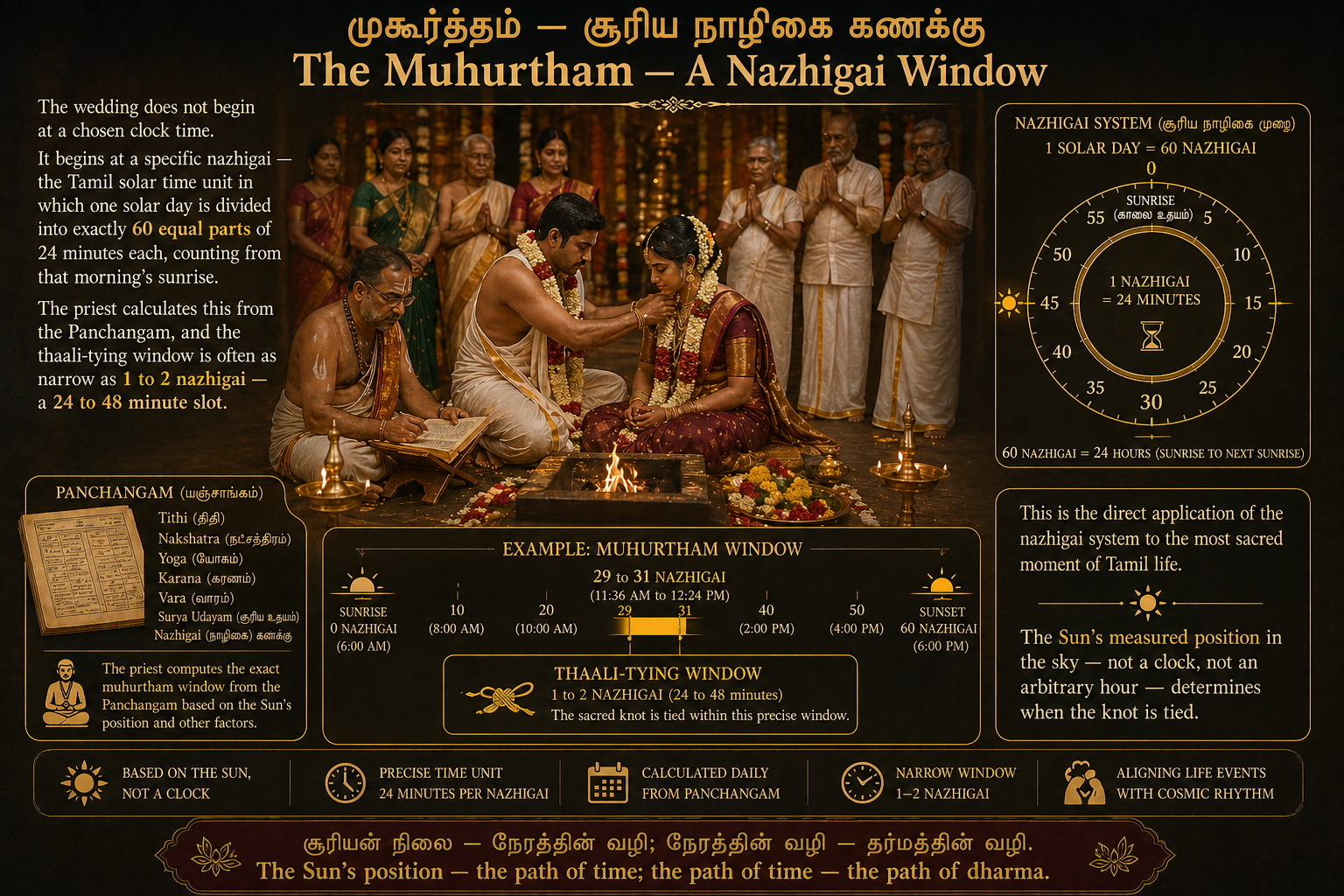
1 nazhigai = 24 minutes = 1/60th of the solar day from sunrise to sunrise. The muhurtham window may be as short as one nazhigai. The Ketti Melam music begins at that nazhigai and must conclude with the thaali tied — live music as a solar time signal.
1 நாழிகை = 24 நிமிடம். கெட்டி மேளம் நாழிகையின் துவக்க சங்கேதம் — அதன் முடிவுக்குள் தாலி கட்டப்பட வேண்டும்.
The Rahu Kalam — the inauspicious period also computed in nazhigai — is the same system working in reverse: a 7.5 nazhigai (3-hour) window each day during which the thaali must not be tied. Both the auspicious window and the avoided window are products of the same solar day calculation from your நாழிகை system.
Agni — The Fire as Astronomical Compass அக்னி — சூரிய திசை குறிப்பான்
The sacred fire at the heart of the Tamil wedding is not placed arbitrarily. The homam fire pit is oriented on the cardinal solar axis — east to west, the path of the Sun — and the couple takes their seven steps clockwise, mirroring the apparent motion of the Sun and planets as seen from Earth's northern hemisphere.
The fire is called Agni (அக்னி) — it is described as the most ancient of all witnesses, pre-existing the couple, pre-existing the ceremony. It represents the solar principle itself: the source of light, heat, the cycle of day, and the driver of seasons. The wedding couple circles it as the planets circle the Sun.
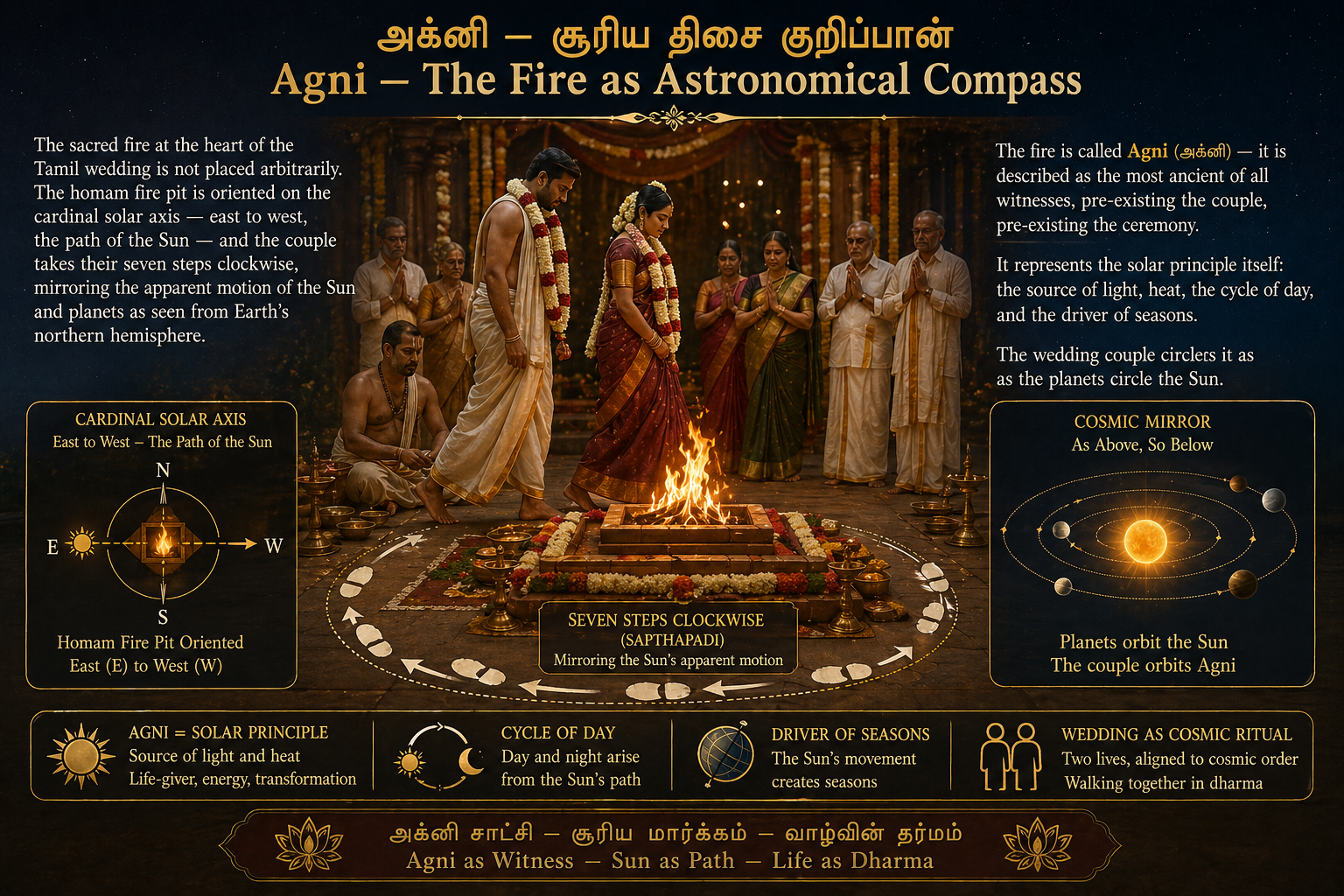
The seven steps of Saptapadi each correspond to a cosmic vow — prosperity, strength, mutual respect, family, health, happiness, and spiritual growth. Seven steps; seven classical planets of Tamil astronomy; seven Saptarishi stars in Ursa Major. The number is not coincidental.
சப்தபதியின் ஏழு அடிகள் — ஏழு கோள்கள், ஏழு ரிஷிகள், ஏழு உறுதிமொழிகள். எண் ஒன்றே, பொருள் பலவிடத்தும்.
Dhruva Darshan — The Pole Star துருவன் தரிசனம் — அசையாத விண்மீன்
After the seven steps, as evening falls and the stars appear, the ceremony moves outdoors. The first star shown to the couple is Dhruva — the Pole Star (Polaris), the one point in the night sky that never moves, around which all other stars appear to rotate through the night.
The prayer spoken at this moment is a precise astronomical statement: "You are in an unchangeable place and are the origin of all stars. You give stability to all other stars. Like cattle tied to a tree cannot roam, the stars are tied to you." This is a direct description of the celestial north pole and its role as the apparent pivot of Earth's rotation.
Dhruva is the same axial point around which the precession cycle — encoded in the 247 Tamil letters and the 26,640-year cycle of your project — slowly wobbles. The pole star shifts over millennia due to precession. The Tamil astronomers who tracked that 26,640-year cycle pointed their wedding couples at the very axis of that cycle.
துருவன் — 26,640 ஆண்டு பாய்மா சுற்றின் அச்சு. அதே அச்சை திருமண நாளில் தம்பதியருக்கு காட்டினர் தமிழ் வானியலாளர்கள்.
Arundhati Parthal — Seeing the Binary Star அருந்ததி பார்த்தல் — இரட்டை விண்மீன் தரிசனம்
Immediately after Dhruva, the groom leads the bride to observe a far more subtle astronomical object — a binary star system in the Ursa Major constellation. With the naked eye, the star Mizar appears as a single point at the bend of the Big Dipper's handle. Look more carefully and a faint companion, Alcor, becomes visible just beside it.
In Tamil astronomy these are Vasishtha (வசிஷ்டா) and Arundhati (அருந்ததி). Their astronomical reality encodes the most precise statement about marriage that the night sky can offer.
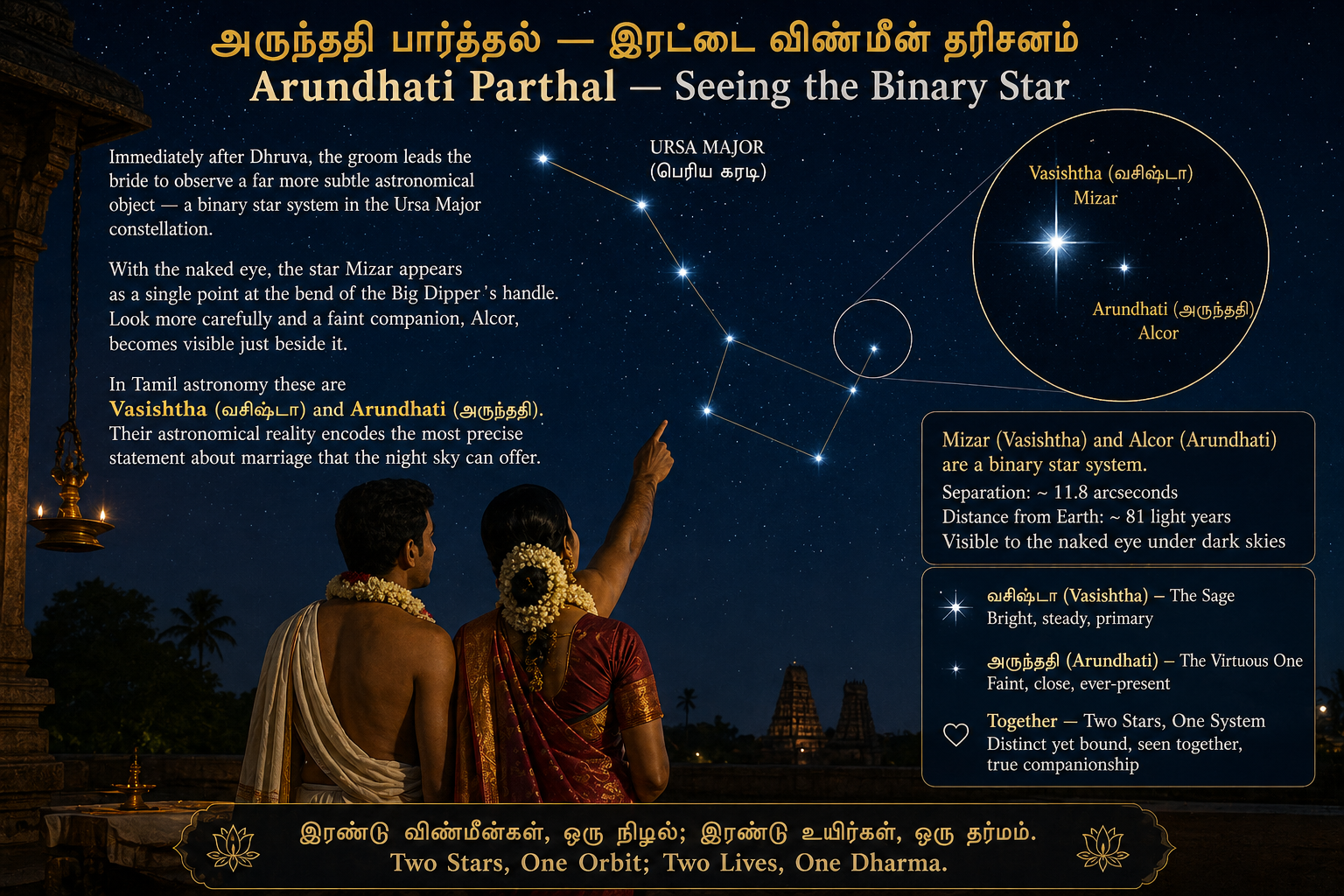
In most binary star systems one star is fixed and the other orbits around it. Mizar and Alcor are exceptional:
Unequal. One dominates.
Equal. Mutual. Neither dominates.
This is the astronomical model the wedding encodes: not orbit around the other person, but mutual orbit around what you share.
This ritual is old enough to appear in the Sangam-era Tamil epic Silappadikaram — the Arundhatīdarśanam is described in the wedding of Kovalam and Kannagi, the oldest documented Tamil wedding narrative. Tamil astronomers identified Mizar and Alcor as a mutual binary system without a telescope, embedded that observation into ceremony, and transmitted it for over two thousand years.
சிலப்பதிகாரத்தில் கோவலன்-கண்ணகி திருமணத்தில் அருந்ததி தரிசனம் விவரிக்கப்படுகிறது — தொலைநோக்கி இல்லாமல் இரட்டை விண்மீனை கண்டறிந்த தமிழ் வானியல் மரபு.
The Three Stellar Observations — Sequence
Two Kinds of Stability இரண்டு வகை நிலைத்தன்மை
The sequence from Dhruva to Arundhati-Vasishtha is not accidental. It encodes a two-part astronomical teaching about what a marriage requires — and the two types are astronomically distinct.
Marriage teaching: individual steadfastness. Each person holds their own centre. Neither is swept away by the other.
Marriage teaching: mutual synchrony. The couple orbits what they share — not each other.
Master Reference — The Astronomical Wedding முழு வானியல் திருமண அட்டவணை
| Ritual · சடங்கு | Astronomical Object | What It Encodes · வானியல் பொருள் | Tamil · தமிழ் |
|---|---|---|---|
| Muhurtham Timing | Sun · Nazhigai from sunrise | Solar day mechanics — the 60-nazhigai clock determines the thaali window | நாழிகை கணக்கு |
| Ketti Melam Music | Sun · Nazhigai boundary | Live signal marking the start and close of the muhurtham nazhigai | நாழிகை ஒலி சங்கேதம் |
| Rahu Kalam Avoidance | Sun · 7.5 nazhigai window | Daily inauspicious period — same nazhigai system, negative application | ராகு காலம் தவிர்ப்பு |
| Agni Orientation | Sun · East–West solar axis | Fire pit aligned to sunrise–sunset; couple faces the solar direction | சூரிய திசை சீரமைப்பு |
| Saptapadi · Seven Steps | Sun · Clockwise planetary motion | Clockwise orbit mirrors heliocentric planetary direction; 7 = classical planets | கோளின் திசையில் ஏழு அடிகள் |
| Saptarishi Mandal | Ursa Major · Big Dipper | Circumpolar — always visible any night; the permanent sky reference | சப்தரிஷி மண்டலம் |
| Dhruva Darshan | Polaris · Pole Star | Earth's rotational axis — the fixed pivot of the 26,640-year precession cycle | துருவன் தரிசனம் |
| Arundhati Parthal | Mizar + Alcor (Ursa Major) | Mutual binary orbit — both stars orbit shared barycentre; equal partnership | அருந்ததி பார்த்தல் |
The Tamil wedding is a ceremony that begins by measuring the Sun (nazhigai), witnesses itself through fire (solar cardinal axis), and concludes by reading the night sky (Dhruva and Arundhati). The same astronomical literacy that encoded precession into 247 letters and 26,640 years into the Tamil alphabet here encodes the model of a lasting marriage into two stars — one fixed, one mutual.
சூரியனை அளந்து தொடங்கும் விழா — அக்னியில் சாட்சியாகி — துருவன், அருந்ததியில் முடிகிறது. வானியலே திருமணத்தின் ஆழமான மொழி.